
Demonstrating commitment to your organization’s overall Quality and Compliance Program can feel daunting. Defining specifics as well as timelines, goals, and operating costs can seem larger-than-life. To streamline the available avenues, this piece aims to examine the Mock Inspection method as a means to promote Regulatory Inspection Readiness within the organization.

Demonstrating Regulatory Inspection Readiness should be actionable, evidence-based, and well documented. By integrating a Mock Inspection, teams will endeavor to mirror responses and actions to regulators in real-time. A popular method, the Hats-On/Off Mock approach, offers a scenario-based Mock Inspection reconstruction where assessors carrying out the roles of Regulators (Hats-On) simulate what can be expected during the actual Health Authority Inspection. The contrast is to offer on-the-spot coaching and re-direction to further Auditee development (Hats-Off).

This scenario is intended to gauge not only compliance, but auditee responses and behavioral components during a Regulatory Inspection. Staff, Subject-Matter-Experts (SMEs), back-room team members, Hosts and Front Room attendees should aim to maintain the simulation and act as if the scenario were live.

Across the Inspection, Quality leaders and auditees should strive to standardize roles, responses as well as adhere to any established Inspection policies as well as develop teams to describe complex Organizational changes or situations:
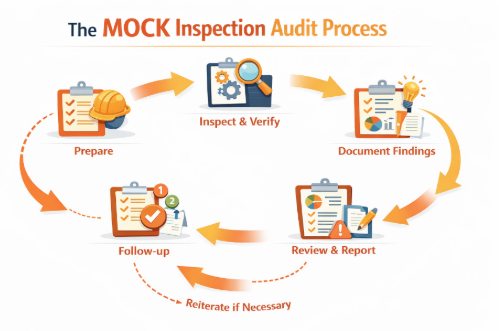

  • Discussions should occur prior to the Mock to determine what percentage should be considered Hats-on/Hats-off. There are various approaches to take based on the experience levels of the staff participating.  Questions can also be addressed regarding back-room preparations, etc.
  • An Agenda is not typically included to mirror a real inspection, various resources are available (for example if Mock is FDA focused: Compliance Program Guidance Manual (CPGM) 7348.810 (Sponsors and CROs) and/or 7348.811 (Clinical Investigators and Sponsor-Investigators)
  • Locate, prepare and submit to any document requests. Define sharing repository/pathway and requisite access
  • Define functional, department teams and workforce involvement to support Mock and prepare the back room process that will be followed
  • Proceed through Mock from reception of Regulators into the Front room through Closing meeting
  • Respond to any detected Findings as a result of the Mock with a clear CAPA (Corrective and Preventive Action) plan with Effectiveness checks
image

Useful examples during the Hats-On/Off simulation during the Mock Inspection may involve:

  • Evaluating a teams’ policies and procedures (Hats-On) followed by input for expediate document management and retrieval (Hats-Off)
  • Appraising drug safety surveillance strategies (Hats-On) as well as refining staff responses to present a succinct reply (Hats-Off)
  • Diving into a specific deviation with the Subject Matter Expert (SME) (Hats-On) followed by suggestions for their storyboard to better explain the situation and remediation efforts (Hats-Off)

To further any organization’s Mock Inspection Readiness or Compliance strategy, Continual Improvement should be built into any Quality Program.  This is underscored by internal and external Audit planning on an annual scale as supported by a risk-based approach. Other strides include conducting GAP analysis upon an existing Quality Management System and designing training opportunities to develop Staff around Inspection behaviors such as Mock simulations and live Inspections.

It is key to highlight a commitment to Quality, Compliance and on-going Improvement. This can be shown through maintaining awareness around updates and revisions to regulations (Regulatory Intelligence), along with performing various Inspection Readiness activities including Mock Inspections.

Ultimately, effective Inspection Readiness is not a one-time exercise, but a continuous, risk-based commitment to quality, compliance, and operational excellence. FDAQRC supports organizations at every stage of this journey by delivering tailored Inspection Readiness programs, including Hats-On/Off Mock Inspections, gap assessments, CAPA development, regulatory intelligence, and targeted training designed to strengthen both systems and inspection behaviors. Leveraging former Health Authority and industry experts, FDAQRC partners with clients to translate regulatory expectations into actionable strategies, ensuring teams are confident, prepared, and inspection-ready—whether facing routine surveillance or for-cause inspections. Through practical simulations and customized quality solutions, FDAQRC helps organizations move beyond compliance toward sustainable inspection success.

This insight was provided by FDAQRC’s Project Manager, Amanda White.
As a Project Manager at FDAQRC Amanda facilitates client communication and manages relationships while providing project oversight. Prior, Amanda gained experience by managing Quality & Regulatory Affairs for a Stem-Cell Transplant Program, Amanda also holds experience with Foundation for Accreditation of Cellular Therapy and designing Quality Management Plans and Systems. Additionally, she has managed a commercial reference laboratory offering Leukemia & Lymphoma Assays. She’s also adept at designing Risk Evaluation & Mitigation Plans and assessing risk via Failure Mode Evaluation tools.

image
DISCOVER MORE